

When your gut acts up, there’s almost always one obvious thing to blame: The last thing you ate, but it’s rarely that simple.
Let’s take a normal day.
You skipped breakfast—you got distracted, the food had the wrong texture, your medication flattened your appetite, or you were already running late.
Lunch was an afterthought.
Then it’s 5pm and you’re suddenly starving, overstimulated, and willing to eat the first thing requiring fewer than 3 decisions (*cough Uber Eats *cough).
You eat fast. Your stomach reacts.
And the meal (the last thing that happened before your gut started acting up) takes the blame for everything that stacked up before it.
The overlap between neurodivergence and gut issues
Gut symptoms like constipation, diarrhea, abdominal pain, reflux, and bloating are reported more often in autistic people. The evidence is stronger for autism than ADHD, where the research is still catching up.
But honestly, you don’t need perfect research to see the practical pathways of how everyday ADHD can make digestion harder: forgotten meals, irregular eating, the daily struggle of planning and preparing food, patchy hydration, appetite scrambled by medication, eating almost nothing all day and then becoming ravenous at night.
There isn’t one mysterious “neurodivergent gut.”
There are just several factors quietly stacking on top of the same digestive system.
Eating requires more executive function than anyone admits

Health advice talks about food as though a balanced meal simply appears the moment your body needs one.
Unfortunately, most meals arrive disguised as a small administrative project.
You have to notice you’re hungry. Decide what to eat. Check what you have. Prepare it. Clean up afterward. And somehow repeat this several times a day, every day, until you die (excuse me, I feel a bit dramatic today).
For someone with ADHD, each step is another place the process can collapse.
So you don’t eat when hunger first appears. You eat when your body starts sending increasingly aggressive follow-up emails. By then you’re depleted and grabbing whatever’s fastest—often too much, too quickly.
Then your gut reacts.
And yeah, the food can definitely play a role. But so does the setup.
Food is a sensory experience

For many neurodivergents, food becomes a sensory question long before it becomes a nutrition question.
Texture. Smell. Temperature. Whether 2 foods are allowed to touch.
And the most important: your favorite brand quietly changed the recipe and committed an unforgivable crime (one of my favorite cafés once changed the recipe for their pistachio ice cream and I still haven’t recovered).
Some foods feel predictable and safe. Others are genuinely hard to tolerate, no matter how healthy someone insists they are.
If you’re a selective eater, instead of pressuring yourself into the “perfect” diet, a better question to ask is:
How can we make the foods that already feel safe a little more nourishing or varied, without removing the thing that makes them safe?
Add something familiar alongside them. Change the preparation. Find a nutritionally similar option with a better texture.
Support works better than turning a meal into an exam.

FREE WORKSHOP
POV: You flush after meals that used to be fine
Reactions. Flushing and bloating after eating. Anxiety that shows up out of nowhere. 2am wake-ups. It’s not random, and there is relief.
Body signals don’t always arrive clearly
Hunger, fullness, thirst, nausea—these are all signals from inside the body. For many NDs, that wiring runs differently.
Hunger goes unnoticed until it’s an emergency. Anxiety and nausea are hard to tell apart. A little bloating becomes impossible to tune out.
Sometimes the signal arrives late. Sometimes it arrives without a useful label. Sometimes someone left the volume turned all the way up.
Digestion naturally creates movement, stretching, pressure, and gas. The sensation is real—but how loud it feels doesn’t tell you how dangerous it is.
Medication and stress change the whole setup

ADHD medication can be life-changing. It can also flatten appetite or stir up the gut.
The classic pattern: barely hungry while the medication is active, then ambushed by ravenous hunger the moment it wears off.
That evening hunger is a completely predictable physiological setup.
Persistent side effects deserve a conversation with your prescriber.
Stress adds another layer.
Sensory overload, constant transitions, social uncertainty, masking—all of it costs energy, and that load shifts appetite, gut movement, muscle tension, and how intensely every digestive sensation registers.
The research won’t let me say masking causes a specific gut condition, and I won’t pretend it does. But sustained stress changes gut function through the gut-brain connection, and that’s hard to argue with.
It’s why the same meal feels fine in a quiet kitchen and completely different after a day of noise, missed meals, poor sleep, and performing “normal” for 9 hours straight.
Look at your day, not just your plate

Picture someone who slept badly, forgot breakfast, took appetite-blunting medication, masked through several meetings, ignored every early hunger signal, came home overstimulated, and ate a large meal fast.
Then the gut reacts, and the internet asks: which food caused this?
That question is too small.
The food could be part of the pattern. But so could the timing, the medication, the portion, the stress, the sensory load, the speed of eating, and everything already happening in the gut that day.
This is one reason Your Daily® doesn’t start by telling you which foods to fear. We look at the conditions digestion is actually happening under.
What you can do without overwhelming yourself

Please don’t try to fix every layer at once. That just turns lunch into a second full-time job, which is where most wellness advice eventually ends up.
Pick the layer causing the most friction:
- If you forget to eat:
tie food to something that already happens—your medication, your coffee, a work break. - If preparing food feels impossible:
keep 2 or 3 default meals that need almost no decisions (Precut, frozen, microwaveable—these are accessibility tools, not moral failures.) - If sensory needs limit your options:
build out from safe foods, and add before you replace. - If medication affects your appetite:
track the timing and take persistent effects to your prescriber. - If meals happen during overload:
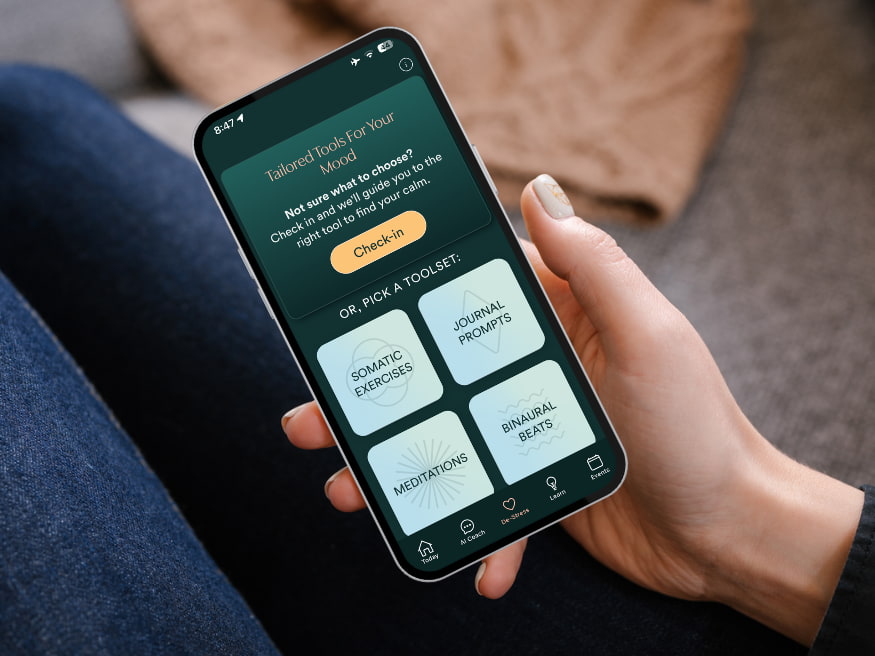
use one familiar Your Daily® tool before you eat. Look around the room, take 2 slower exhales, let your shoulders drop. Or just pick something from the DeStress Library.
None of these are magical digestion switches. They just give the meal better conditions than arriving in the middle of an internal fire drill.
One experiment for next month
Choose one meal or snack that regularly goes sideways. Then add one layer of support: a reminder, a default food, easier prep, less sensory input, a regulation tool, or a conversation with your prescriber.
One layer. Not the full wellness Olympics by Monday.
Neurodivergent people don’t need another flawless gut protocol built for a life they don’t have. They need support that works with the sensory needs, executive function, medication, nervous system, and body signals they actually live with.
Which layer feels most relevant right now: timing, sensory load, medication, body signals, or stress?
You don’t have to solve all of them. Pick the one that shows up most often and start there.
Talk soon,
Hussein