

If your stomach keeps hurting, “regulate your nervous system” can sound like “have you tried calming down?” with a more fancy vocabulary.
Especially if you’ve already tried the breathing exercise. You followed the instructions. Your stomach still hurt. And now, on top of digestive problems, you also have performance anxiety about breathing.
Here’s the honest version: there is something real behind this advice. It’s just been stretched to cover a lot of things it can’t do.
I want to mention beforehand: I work on the science at Your Daily®, where these practices are part of the daily plan. So I’ve got skin in this game—which is exactly why I want to tell you what these tools can and can’t do rather than asking you to just trust a buzzword.

What does “regulating your nervous system” even mean?
Mostly, it means doing something—breathing, relaxing your muscles, moving, shifting your attention—that helps your body go from wound up to more settled.
That’s it! It’s not one single movement or treatment. It’s not a diagnosis. And feeling stressed doesn’t mean your nervous system is broken or that you’ve failed some regulation exam.
Permanent inner calm is not the goal. Nobody needs to become a monk, that’s social media nonsense. The goal is being able to settle enough to eat, rest, be with difficult emotions, and get on with your evening.
Why your gut is part of this
Your gut and your brain are in constant conversation. And in IBS, the gut works a bit like a smoke alarm that goes off every time you make toast. Ordinary amounts of gas can register as pain. Digestion can also move faster or slower than usual. That sensitivity is real, and it has a physical cause.
Stress turns the volume up. Then the symptoms stress you out. So you start dreading dinner, scanning for the nearest bathroom, running the math on whether tonight’s ingredients are going to go wrong.

Completely understandable. Also, unfortunately, part of the loop.
None of this means only stress caused your gut problem. Food, medication, infections, and plenty else matter too. It just means your nervous system is one more place you can get help—not the only one, and not the one that cancels out the others.
What actually works (and what doesn’t)
Short breathing practices can help you feel calmer.
A 2023 study found that five minutes a day of breathing exercises improved people’s mood and anxiety over a month. Useful. But calmer isn’t the same as cured, that study didn’t show breathing treats IBS.
Structured gut-brain therapy can actually improve gut symptoms.
This is the bit that surprises people. Therapies like gut-focused CBT and gut-directed hypnotherapy have improved IBS symptoms in large trials—not just how people cope with the pain, but the symptoms themselves.
In one trial, roughly 1 in 3 people in hypnotherapy got adequate relief, compared with about 1 in 6 in the comparison group.
Two important footnotes: These were proper courses of treatment over weeks or months, not one video. And some people didn’t get that relief. Still, it’s good enough that the American College of Gastroenterology lists gut-directed psychotherapy as a treatment option for IBS.
Here’s the catch, and it applies to us too: evidence for those specific therapies doesn’t automatically transfer to every app, course, or Instagram post using the words “nervous system.”
Where the promises go too far
All of these things can be true at once:
- Something can help you
- You can have a theory about why it helped
- It can be proven to treat a condition.
These can also be three different things.
You might feel better after humming. Great. That doesn’t mean humming alone will fix your bloating.
And on the flip-side, one breathing exercise flopping doesn’t mean the whole gut-brain thing is nonsense.
I’d be suspicious of anything that blames every symptom on one mechanism (parasites, mold, SIBO, etc), promises a total reset in a couple of days, or suggests that if it isn’t working, you’re just not trying hard enough.
And watch for the sneaky one: regulation turning into another thing to get right. You sit down to eat and start checking whether you’re calm enough, breathing correctly, sending the right signals. You were already worried about dinner. Now dinner has an entrance exam.
A good practice should help you live your life. Not become one more test you have to pass first.

How to try it without making it a project
Skip “fix my nervous system.” That’s not a task, it’s a personality renovation. Pick one moment instead.
- Name one specific situation.
The rush from work straight into dinner?
Worrying about symptoms when you’re out?
Not being able to settle after a stressful meeting?
Pick one. - Try one small thing there.
For the work-to-dinner rush, maybe that’s closing the laptop and doing a two-minute breathing exercise first. Practice it on an easy day, so you’re not learning the instructions mid-flare. And no, you don’t have to hit a certain level of calm before you’re allowed to eat. - Look for a small, useful differences
Were you a bit less tense? Did you spend less of dinner checking in on your stomach? That absolutely counts. You’re not running a clinical trial on yourself so don’t feel like you have to keep perfect notes here.
If something consistently makes you feel worse, drop it.
Relaxation exercises can occasionally make people more anxious, and you don’t owe a breathing technique your loyalty. And if your symptoms are getting worse or not going away, that’s a doctor’s job, not a job for a better exercise.
Why we built Your Daily® the way we did
The approaches above with real results had a few things in common. They weren’t a single social media video: They were structured, they ran over weeks, and they went further than relaxation.
They also addressed eating patterns, the loop between stress and symptoms, and how you respond when your gut acts up.
We built Your Daily® on that model. Our Calm the Gut plan runs for 10 weeks, with short daily practices, plain-English lessons on why your gut reacts the way it does, mealtime tools, and help spotting your own stress patterns and triggers.
On the days something spikes, the DeStress Library lets you find a tool based on how you feel in the moment.
Everything is organized into structured plans that I review for accuracy, so you don’t have to piece it together from 38 social media posts and 4 podcasts.
So, can nervous system regulation help your gut?
Yes. Structured programs can reduce gut symptoms, especially in IBS. Short practices like breathing exercises and guided relaxation help in a different way, by easing the worry and hypervigilance that come with those symptoms. Your Daily® includes both.
Less pain matters. So does enjoying dinner without spending the evening monitoring your stomach.
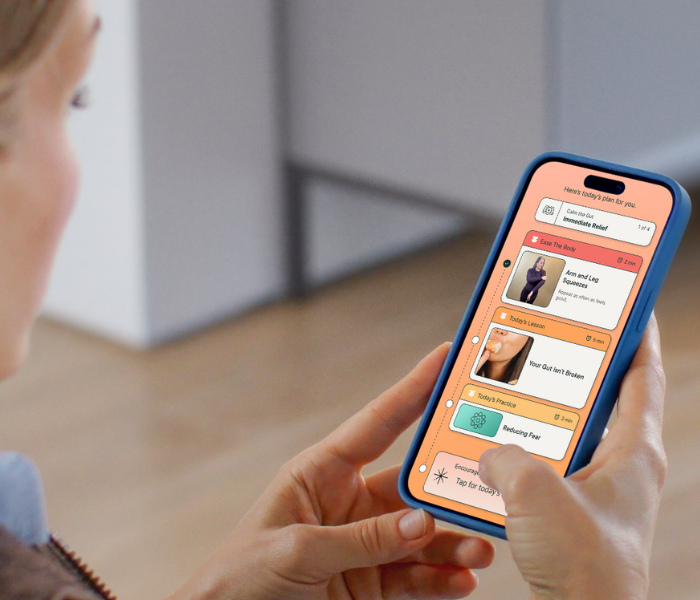
Try Your Daily® and get your plan
That’s it from me. Go eat something nice, preferably without an entrance exam (pistachio ice cream if your gut allows it. I’m legally required to mention pistachio ice cream at least once per newsletter. Okay that’s a lie but I wanted you to know how much I like it).
And if your gut decides to be difficult anyway, you haven’t failed at anything. You’re just a person with a gut. Which, statistically, is most of us.
Talk soon,
Hussein