
Picture a dinner out.
You haven’t eaten anything yet. You’re still reading the menu. But your stomach has already started its own little meeting. Something tightens. You check where the bathroom is. You order the “safe” thing, even though the pasta carbonara looked amazing. And for the rest of the evening, half your attention is on the conversation, and the other half is on your gut, waiting for it to do something.
(Growing up with 3 brothers, my restaurant problem was the opposite. I ate so fast that my stomach only found out about dinner after I’d paid.)
This happens with IBS, but also with a nervous stomach, bloating that shows up with stress, or a gut that’s fine at home and acts up the moment you leave the house.
If that sounds familiar, you’ve probably heard two explanations for it.

Explanation one: “It’s all in your head.”
Usually delivered by someone who has never had to plan a day around bathroom access. And it’s wrong. Gut symptoms are physical, they’re measurable, and they deserve proper medical attention. Nobody imagines their way into cramps.
Explanation two: “It’s purely physical. Just find the right food.”
This one is partly true. Food and your gut’s sensitivity matter. But they can’t explain why your stomach reacts before the food has even arrived.
So if it isn’t imagined, and it isn’t only the food, what is it?
Why does my stomach act up before I eat out?
Bodies are excellent at learning. That’s usually a good thing. Touch a hot stove once, and you don’t need a second lesson (unless you’re me, then you need 16 lessons).
The same learning happens with your gut. If your stomach acted up a few times at restaurants, or in the car, or before important meetings, your body starts connecting the place with the problem. After a while, the place alone is enough. Your system goes on alert before anything has happened, the same way you flinch before a needle touches your arm.
In studies on gut pain and learning, people saw a neutral image on a screen, like a simple shape, right before they felt a mildly uncomfortable sensation in their gut. After a few rounds, the image alone was enough to make their bodies tense up. Your nervous system doesn’t need much to make a connection.
And being on alert has a cost. When your body expects trouble, it turns up the volume on signals from your gut. You notice every gurgle. Normal sensations start to feel like warnings. People with more gut-specific worry tend to report stronger symptoms, which makes sense: a system scanning for danger will find something.
So the loop goes like this: a few bad experiences teach the alarm, the alarm makes you tense up, tension makes your gut feel worse, and that teaches the alarm again.
The good news is that anything learned can be updated.
Why do breathing exercises work at home but not at restaurants?

You might already practice calming down. Maybe you breathe slowly before meals at home, and it really helps. Then you go out to eat, and your stomach behaves like it has never heard of breathing.
That isn’t a sign the practice doesn’t work. It’s how this kind of learning is built.
Mark Bouton, a learning researcher who has studied this for decades, found that when a body unlearns an alarm, the old learning usually isn’t erased. Your brain adds a new layer on top of it: “this situation is actually okay now.” But that new layer is tied to the place and situation where you learned it.
So your body learned “the kitchen is safe.” It didn’t learn “food is safe everywhere.” (To be fair, that’s also my approach to bread outside Germany. Trust has to be earned.) In a new place, the new layer can stay behind, and the old alarm can show up again.
This is frustrating, and also weirdly reassuring. When the alarm comes back in a new setting, your progress is still there. You’ve found a place the new learning hasn’t reached yet.
How do you make the calm travel with you?
You don’t have to take your gut on a world tour. A few small changes make the calm more portable.
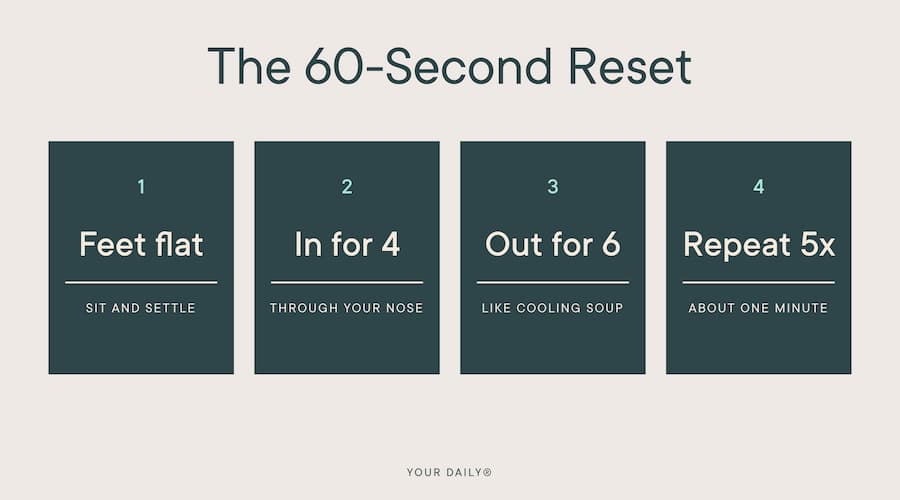
1. Use the same 60-second reset everywhere, not just at home.
The 60-second reset
- Sit with both feet flat on the floor.
- Breathe in through your nose for about 4 seconds.
- Breathe out slowly through your mouth for about 6 seconds, as if you were cooling a spoonful of hot soup. Let your shoulders drop as you breathe out.
- Repeat 5 times. (about a minute)
Use it at home first. Then use the exact same reset in other places. Because it’s identical every time, it works like a bridge: it brings a bit of the calm from where you learned it into where you are now.
(If anyone asks why you’re breathing at your soup, tell them it’s a family tradition.)
2. Practice in more than one place.
Calm learned in one setting stays in that setting. Calm learned in several settings spreads further. Start easy: your desk, a friend’s kitchen, a quiet cafe at an off-peak time (off-peak is also when cafes are most likely to still have pistachio ice cream. I’ve done the research. Extensive research.)
Then slowly move toward the places where your stomach reacts most.
3. Start with a safe food in a slightly tricky place.
Don’t combine your hardest food with your hardest situation. Pick something your gut normally tolerates well, and eat it somewhere that makes you a little tense. That gives your body a new experience to learn from without overwhelming it.
4. Expect the old alarm to visit sometimes.
On a stressful day, in a new restaurant, after a bad night, it may show up again. That’s the old layer, which is still there. You haven’t failed. Do your reset, and let the new experience count.
And if your symptoms are new, getting worse, or come with things like blood in your stool, unexplained weight loss, or pain that wakes you up, please see a doctor first. Calming your nervous system works alongside medical care. It doesn’t replace it.

One small experiment for this month
Pick one situation where your gut tenses up before anything happens. The restaurant, the car, the morning before work, whatever yours is.
Do the 60-second reset there three times this month, right when you arrive. Afterward, notice one thing: was the tension a little smaller, a little shorter, or the same?
If it got smaller or shorter, the new learning is starting to reach that place. If it stayed the same, that place needs a few more rounds, so keep going. You don’t need to write anything down. Just notice.
How Your Daily® helps
This is a big part of why we built Your Daily® the way we did.

The Calm the Gut plan runs over 10 weeks:
- short daily practices
- plain-English lessons on why your gut reacts the way it does
- meal-time tools
- and help spotting your own patterns
Because it lives on your phone, you can do the same practice at home, at work, and in the restaurant parking lot. That’s exactly what helps the new learning travel. And when something spikes, the DeStress Library lets you find a tool by how you feel right now.
👉 You can try it free for 3 days. And if you use my link, you get 20% off your first year.
Next time your stomach starts its pre-meal meeting, you’ll know what it’s doing, and you’ll have something to try.
Talk soon,
Hussein